
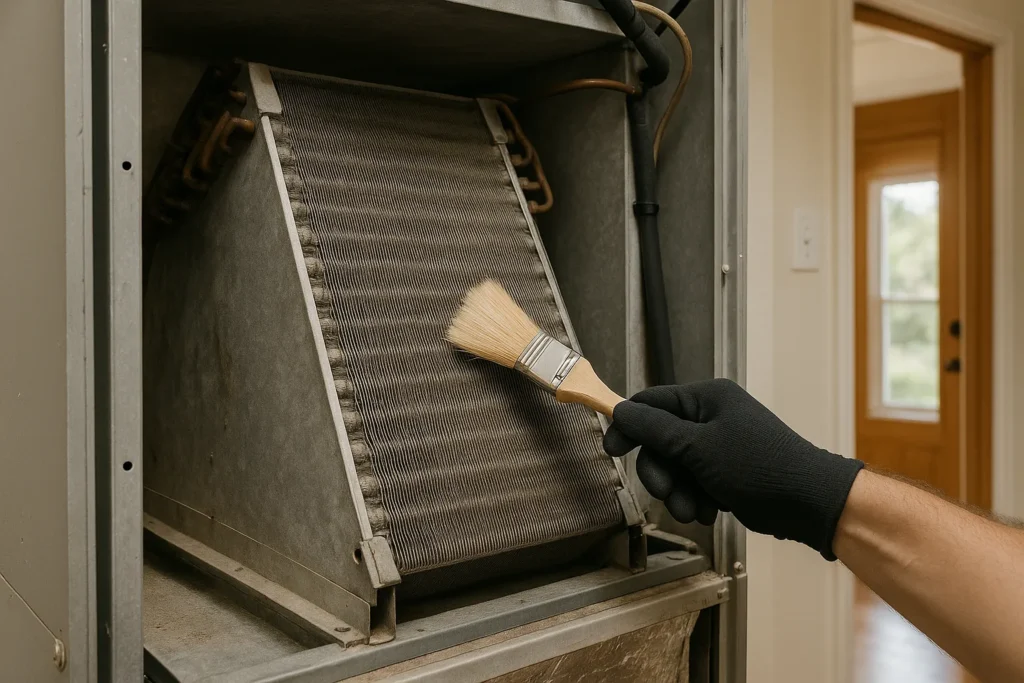
What do the coils actually do?
The condenser coil outdoors rejects heat from the house. It sits in the weather collecting grass clippings, pollen and dust. The evaporator coil indoors absorbs heat from the air passing over it, and loads up more slowly with whatever gets past the filter.
What happens when coils get dirty?
- Cooling that has gradually weakened without ever failing outright.
- Longer run times for the same result, and a higher power bill.
- Higher operating pressures and more strain on the compressor.
- On the indoor side, restricted airflow that can lead to a frozen coil.
There is rarely a moment where it breaks. That is what makes it easy to miss.
What does coil cleaning involve?
Clean the coil appropriately for its condition and type, confirm airflow, and check whether anything else contributed. Where a coil has loaded up quickly, the filter arrangement or the duct system is worth a look.
What do you not offer?
Coil cleaning is not duct cleaning, and we do not currently advertise duct cleaning, air purification or humidifier services.
Common questions
How often should coils be cleaned?
It depends on the setting. Outdoor units near mowed grass or heavy pollen load faster. It is one of the things a tune-up visit assesses rather than a fixed schedule.
Can I clean the outdoor coil myself?
Rinsing loose debris from the outside with the power off is reasonable. A pressure washer will flatten the fins and make things worse, and the indoor coil is not a homeowner job.
Will cleaning the coils fix my cooling?
If dirty coils are the cause, it restores capacity that was lost. If the real problem is charge, a component or the ducts, cleaning alone will not solve it, which is why we look first.
Is this the same as duct cleaning?
No, and duct cleaning is not a service we currently offer.
Reviewed and updated September 2026. Prices shown are owner supplied typical ranges, confirmed after an assessment. If anything here looks out of date, call (615) 400-4993 and tell us.