
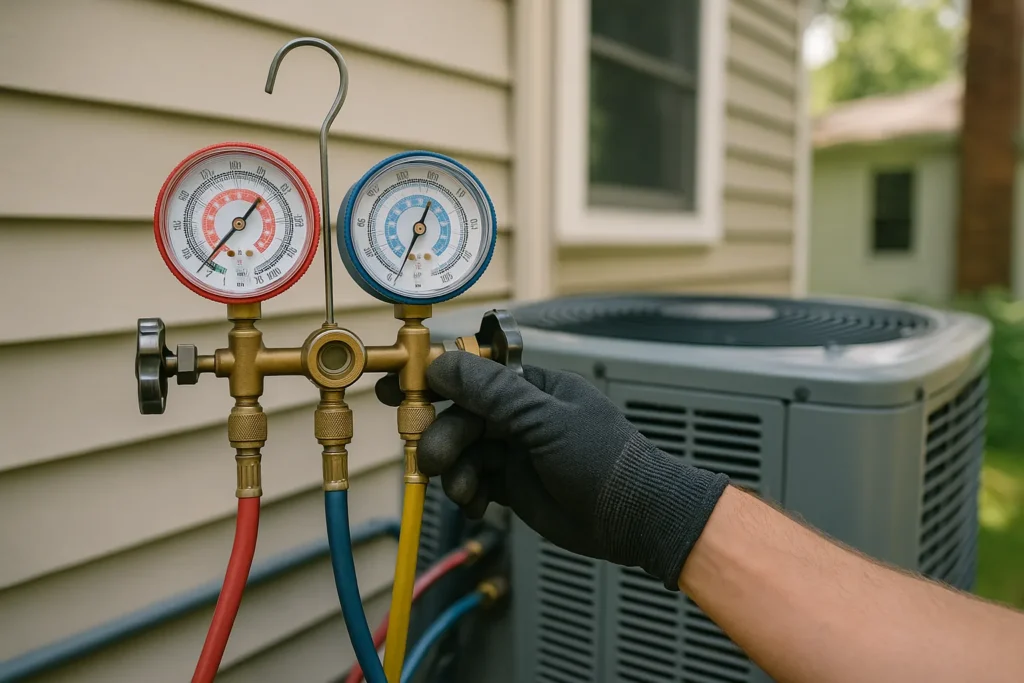
Why is my refrigerant low?
This is the single most useful thing to understand about it. A refrigerant circuit is sealed. If the charge is low, it escaped. Adding more without addressing where it went means you will be in the same position again, having paid twice.
That is why we treat low charge as a symptom and look for the cause.
What are the signs of a low charge?
- Cooling that has gradually weakened over a season rather than stopping suddenly.
- Ice forming on the refrigerant line or the indoor coil.
- The system running far longer than it used to for the same result.
- A hissing or bubbling sound near the equipment.
These overlap with airflow problems, which is why it gets confirmed at the equipment rather than assumed.
Does the type of refrigerant matter?
Systems are designed for a specific refrigerant and it is not interchangeable. R-410A and R-32 are different, and neither is the older R-22 that people often still call Freon. We charge the system with what the equipment is specified for.
What will this cost?
A recharge typically runs priced after an assessment, depending on the refrigerant the equipment takes and how much it needs. If a leak has to be addressed, that is scoped and quoted separately, and you approve it before it happens.
This is an owner supplied typical range, not a quote. Final scope and price are confirmed after an assessment.
When is a recharge not the answer?
If the leak is in the evaporator coil on older equipment, the sensible conversation may be about replacement rather than repeated recharges. We will lay that out honestly.
Common questions
How much does a refrigerant recharge cost?
Typically priced after an assessment, depending on the refrigerant your equipment takes and how much it needs. Final price is confirmed after we have looked.
Why can you not just add refrigerant?
We can, but it will leak out again. Refrigerant is not consumed in normal operation, so low charge means there is a leak to find.
Is Freon the same as what my system uses?
Probably not. Freon is a brand name commonly associated with R-22, an older refrigerant. Most systems now use R-410A or R-32, and they are not interchangeable.
How often should a system need recharging?
It should not need it at all under normal operation. A system that needs regular top-ups has a leak.
Reviewed and updated September 2026. Prices shown are owner supplied typical ranges, confirmed after an assessment. If anything here looks out of date, call (615) 400-4993 and tell us.