
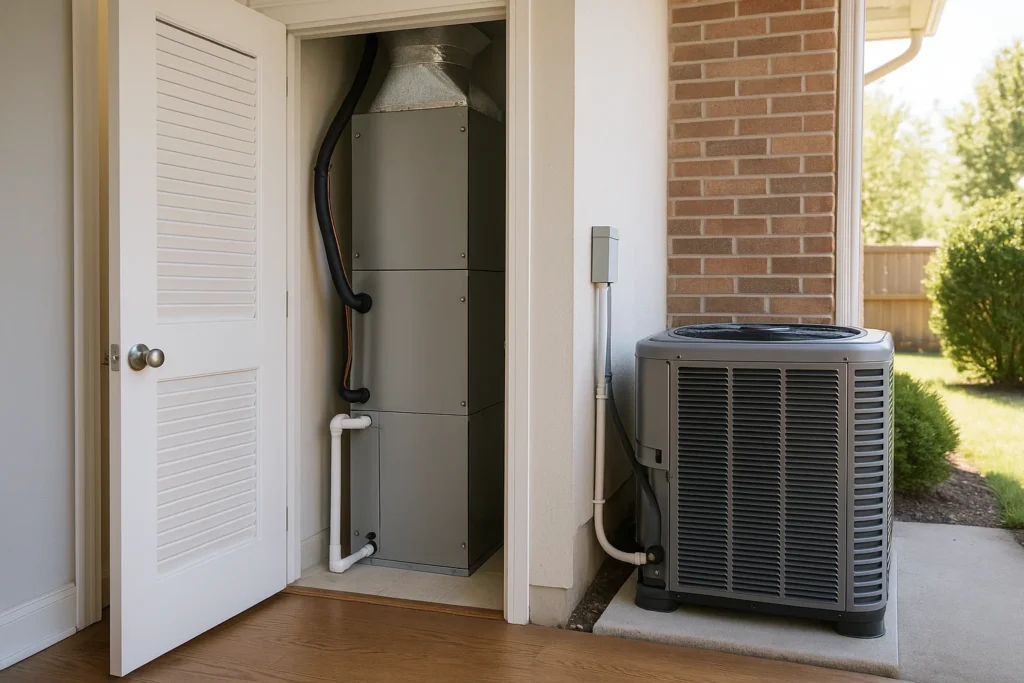
What does a full system replacement include?
Heating and cooling replaced as a matched system: a furnace with an air conditioner, or a heat pump handling both. Matching matters because the indoor and outdoor equipment are designed to work as a pair, and mismatched equipment rarely delivers what either half was rated for.
When is replacement actually the right call?
Not on a birthday. Age alone is a weak signal, and plenty of older equipment runs well while some newer equipment has been through a hard life. What actually matters:
- What has failed. A compressor or a leaking evaporator coil is a different conversation from a capacitor.
- The repair history. One fault is a repair. A pattern across recent seasons is information.
- The cost comparison. When a repair starts approaching a meaningful share of replacement cost on tired equipment, the maths changes.
- Comfort problems that were never solved. If the system never did the job properly, replacing like for like will disappoint you.
“If a repair will get you through the season, we will tell you, even when a new system is the bigger sale.”
What will this cost?
Priced after we have assessed your home. The range is wide because the jobs genuinely differ: equipment selected, whether it is a furnace and AC or a heat pump, access at the property, and whether duct modifications are needed. This is an owner supplied typical range, not a quote. We confirm scope and price after assessing your home.
Do the ducts need to change too?
New equipment connected to duct that leaks or was never laid out well will underperform, and you will have spent a lot to be mildly disappointed. Where the ducts are part of the problem we will say so. See ductwork.
Can you replace only part of the system?
If only one half of the system has failed, condenser replacement or air handler replacement may be options, with compatibility caveats we will explain honestly.
Repair or replace: how we weigh it
| What we look at | Points toward repair | Points toward replacement |
|---|---|---|
| What failed | A wear item such as a capacitor, contactor or fan motor | Compressor, leaking evaporator coil or cracked heat exchanger |
| Repair history | First real fault the system has had | Repairs stacking up across recent seasons |
| Condition of the rest | Remaining equipment looks sound | Several components visibly tired |
| Cost comparison | Repair sits well below replacement cost | Repair approaches a meaningful share of replacement |
| Comfort history | System kept the house comfortable until now | It never really kept up, which may be sizing or ductwork |
No formula decides this. We look at your equipment and explain what we find. See the repair or replace guide for the longer version.
Common questions
What is the $5,000 rule for air conditioners?
It is a rule of thumb people use: multiply the age of the equipment by the repair cost, and if the result is over $5,000 you lean toward replacing. It is a conversation starter, not an answer. We would rather look at what actually failed, the repair history and the condition of the equipment than run a formula.
What is considered old for an HVAC system?
People generally start asking the question somewhere past the ten to fifteen year mark, but age on its own is a weak signal. Equipment that has been maintained and lightly used can outlast equipment half its age that never was.
What does a full HVAC replacement cost?
Typically quoted after an assessment depending on the equipment and the scope of the work. Final scope and price are confirmed after we assess your home.
Should I replace the whole system or just one part?
It depends on what failed and whether the remaining equipment is compatible and in reasonable condition. We will lay out both options rather than defaulting to the larger one.
Will a new system fix the room that is always too warm?
Not on its own if the cause is the duct system. That is worth establishing before you spend on equipment.
Reviewed and updated September 2026. Prices shown are owner supplied typical ranges, confirmed after an assessment. If anything here looks out of date, call (615) 400-4993 and tell us.